A B2B Buyer's Guide to Sourcing Dehydrated Onion Products from India
By Vistara Global Trade · · 4 min read

Dehydrated onion is one of the most widely used dry ingredients in the food industry. It appears in seasoning blends, instant soups, sauces, snacks, ready meals and food service kitchens around the world. For B2B buyers, sourcing it well is less about finding "onion" and more about finding the right form of onion, in the right packing, for a specific application. This guide walks through the main dehydrated onion formats, how to evaluate them and the details worth clarifying before you request a quotation.
Why buyers choose dehydrated onion
Fresh onion is bulky, perishable and labour-intensive to prepare at scale. Dehydrated onion removes much of that work: it is lighter to transport, easier to store and ready to use. For manufacturers, it also makes dosing more consistent, because a measured quantity of a dry ingredient is easier to control than variable fresh produce. These practical advantages explain why dehydrated onion is a staple in so many dry and processed food categories.
The main forms of dehydrated onion
Flakes or kibbled onion
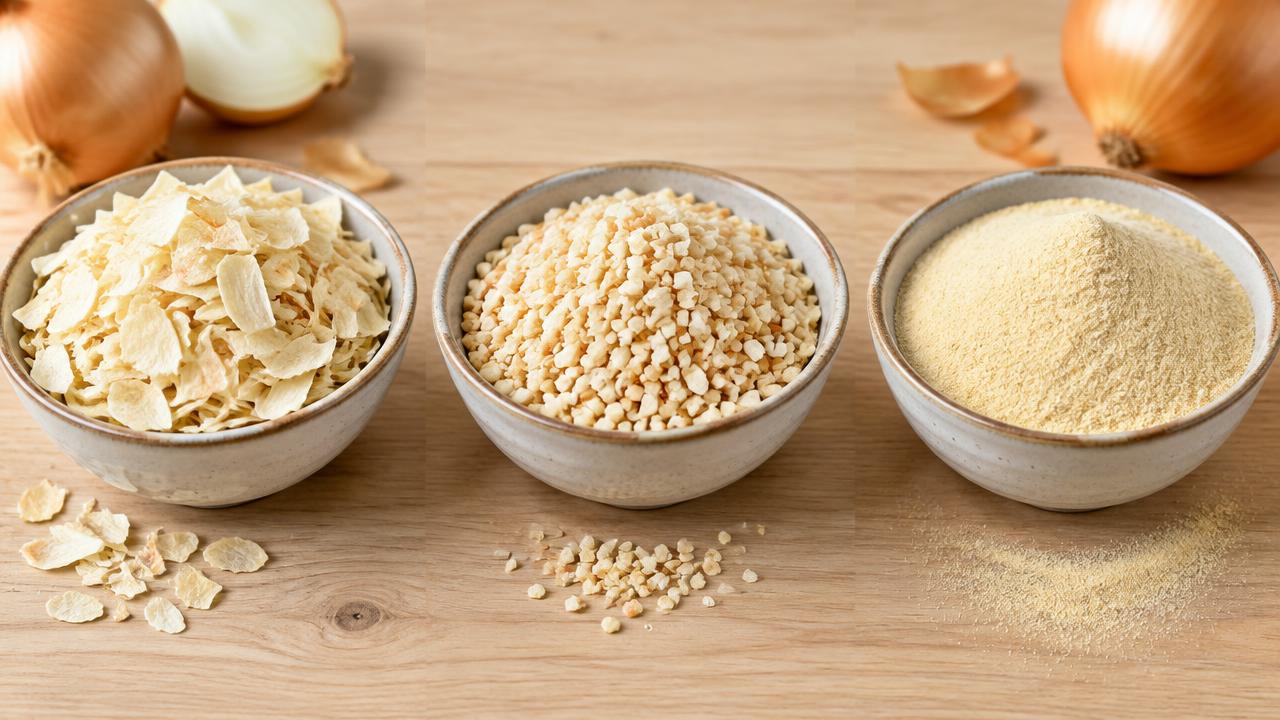
Flakes, also called kibbled onion, are cut onion pieces that have been dried. They are the largest dry format and remain visible in the finished product. Buyers often choose flakes for soups, sauces, ready meals and toppings where the consumer should see onion pieces. Flakes are commonly offered in white, red and pink onion varieties.
Granules
Granules are smaller particles that sit between flakes and powder. They are usually described by mesh size, a measure of particle size based on sieve openings. Typical ranges include 8–16, 16–24, 24–40 and 40–80 mesh, with lower numbers indicating larger particles. Granules flow well and add a slight texture, making them popular in dry rubs, seasonings and bakery toppings.
Powder
Onion powder is dried onion milled finely. It disperses evenly and leaves no visible pieces, which makes it the natural choice for seasoning blends, snack coatings, marinades and smooth sauces.
Fried and coated fried onion
Fried onion is sliced onion that has been fried and dried to a crisp, golden finish. Coated fried onion is lightly coated before frying for extra crunch. Both are ready-to-use ingredients that save kitchens and manufacturers the time and equipment needed for in-house frying, and they are widely used as toppings and as flavour bases in rice dishes and gravies.
Evaluating the right format for your application
Start with how the ingredient will behave in your product. A few practical questions help narrow the choice:
- Should onion be visible? If yes, flakes or coarser granules are likely candidates. If not, consider powder or fine granules.
- How will it be mixed? Powders blend evenly into dry mixes and liquids. Larger particles may separate in some blends, which is worth testing.
- Will it be rehydrated? Products such as soups and sauces rehydrate onion during preparation, so consider how the pieces should look and feel after cooking.
- Which variety suits your product? White, red and pink onion differ in appearance and flavour character, so choose the one that fits your recipe and market.
Practical example: a manufacturer of instant noodle seasoning sachets may prefer onion powder or fine granules for even flavour, while a ready-meal producer might specify flakes so that onion pieces are visible in the final dish.
Product and packing details to request
When preparing an enquiry, clear information on both sides prevents misunderstandings later. Useful details to request or confirm include:
- The exact product name and format, including onion variety.
- Mesh size range for granules, if relevant.
- Packing size and type, for example 14 Kgs for flakes or 20 Kgs for granules, depending on the supplier's list.
- Any technical specifications your quality team requires, such as particular test parameters.
- Documentation you will need for your market.
Only rely on specifications that the supplier has actually confirmed for the product. If a value matters to you, ask for it explicitly rather than assuming it.
What to clarify during supplier discussions
Beyond the product itself, a productive supplier conversation usually covers:
- Quantities: Share your estimated volumes, and whether you need a trial quantity first.
- Destination: The destination country affects documentation, shipping and commercial terms.
- Packing preferences: If you need a packing size different from the published list, raise it early.
- Samples: Ask whether samples can be arranged so your team can evaluate the product.
- Communication: Agree on who your contact will be and how updates will be shared.
It is good practice to put the key points in writing so that both parties have the same understanding before a quotation is prepared.
Common mistakes to avoid
Buyers sometimes request "onion powder" when their process actually needs granules, or specify a mesh range without testing it in their blend. Others leave out the destination country or packing preference, which slows down the quotation. Taking a few minutes to describe your application in detail usually saves days of back-and-forth.
Conclusion
Sourcing dehydrated onion from India is straightforward when you know which format suits your product and you communicate your requirements clearly. Decide whether you need flakes, granules, powder or fried onion; confirm the variety, mesh size and packing; and discuss quantities, destination and documentation openly with your supplier.
Vistara Global Trade lists dehydrated onion flakes, powder and granules in white, red and pink varieties, as well as fried, coated fried and fresh fried onion. Browse the catalogue or send us your requirements and our team will review your enquiry.