Onion Flakes vs Onion Powder vs Onion Granules: Choosing the Right Ingredient
By Vistara Global Trade · · 4 min read
Onion flakes, onion powder and onion granules all start from the same raw material, yet they behave very differently in a recipe or production line. Choosing the right one affects the appearance, texture and consistency of your finished product. This article compares the three formats and offers practical questions for food manufacturers and ingredient distributors deciding between them.
Physical form: the core difference
The simplest way to understand the three formats is particle size.
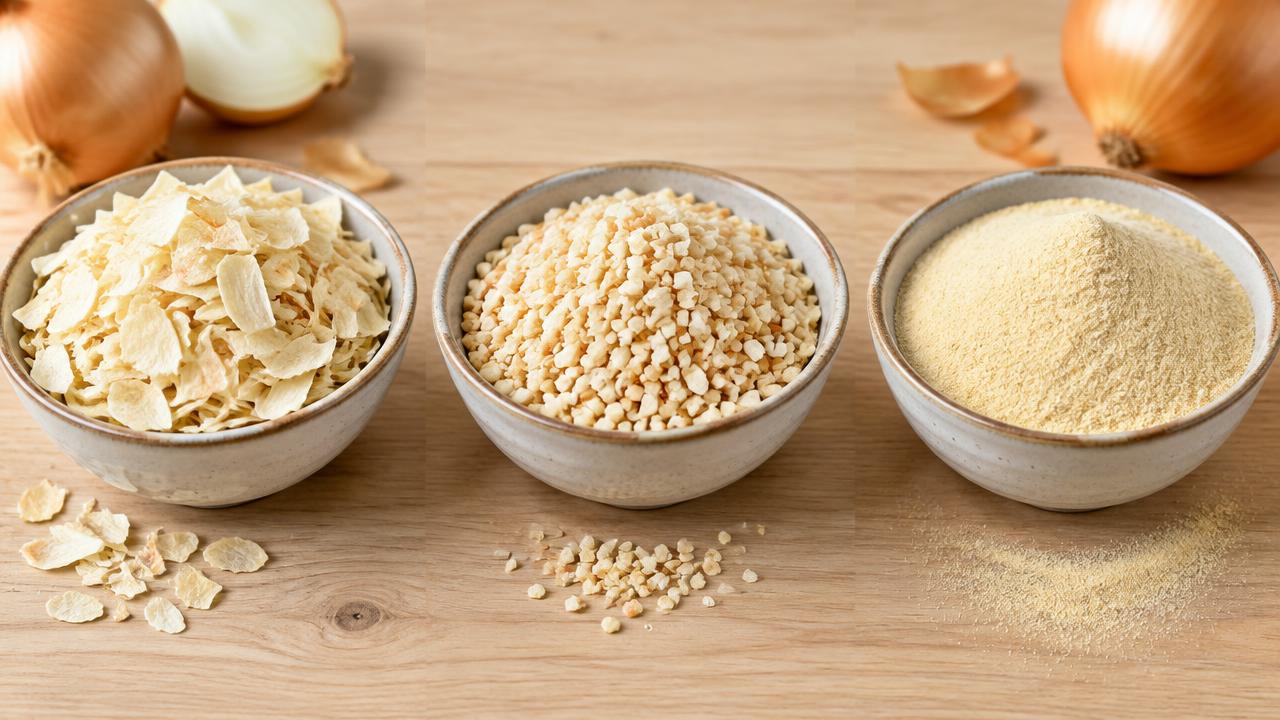
- Flakes are the largest pieces: cut onion that has been dried. They are clearly recognisable as onion.
- Granules are smaller, roughly uniform particles. They are often sold in mesh ranges such as 8–16, 16–24, 24–40 and 40–80, where a lower number means a coarser particle.
- Powder is finely milled, with no visible pieces.
Because particle size changes how an ingredient looks, flows and disperses, it is the first thing to consider when choosing a format.
Typical uses of each format
Onion flakes
Flakes are typically chosen where onion pieces should be seen in the final product. Common examples include dry soup mixes, sauces, ready meals, pickles and garnishes. After cooking or rehydration, flakes provide a texture closer to fresh onion than finer formats.
Onion granules
Granules are frequently used in dry rubs, seasoning blends, bakery toppings and meat seasonings. They offer some visible texture in coarser mesh sizes while flowing well in production equipment. Finer granules can behave more like a coarse powder.
Onion powder
Powder is a staple of seasoning blends, snack coatings, marinades, dressings and smooth sauces. Its fine texture allows it to blend evenly with salt, sugar, spices and other powders so that each portion carries a similar flavour.
Handling considerations
Each format brings different handling characteristics that are worth thinking about before you commit.
- Flow and dosing: Granules generally flow freely and are easy to dose. Powders can be more prone to clumping and dust, depending on conditions, so handling and storage practices matter.
- Blending: When particles of very different sizes are mixed, they can separate during transport or filling. Matching the onion particle size to the rest of your blend helps keep it uniform.
- Rehydration: Larger pieces take longer to rehydrate than smaller ones. In quick-preparation products such as instant soups, this can influence your choice.
- Appearance: If visible onion is part of your product's appeal, powder will not deliver it. If visible pieces would be a defect, flakes are unsuitable.
These are general considerations. Actual behaviour depends on the specific product, your formulation and your process, so testing a sample in your own conditions is always worthwhile.
Practical examples
A snack manufacturer coating potato chips with a sour cream and onion seasoning would normally want onion powder, because it sticks to the chip surface and blends with other powders. A producer of a dry vegetable soup mix might combine flakes for visible pieces with a little powder for background flavour. A spice company packing a grill rub for retail might select 16–24 or 24–40 mesh granules to give the rub a pleasant texture without large pieces.
For ingredient distributors, the choice also depends on customers. Stocking more than one format, or more than one mesh range of granules, can help serve buyers with different needs.
Questions to ask before choosing a format
- Should onion be visible in the finished product?
- What other ingredients will it be blended with, and what are their particle sizes?
- Will the product be rehydrated, cooked, baked or eaten as is?
- Which onion variety—white, red or pink—fits the recipe and the target market?
- What packing size suits your storage and production volumes?
- Which specifications does your quality team need confirmed before approval?
Writing down your answers before contacting a supplier makes the conversation faster and more productive.
Avoiding unsupported assumptions
It is tempting to assume that a given format will perform in a particular way, but results vary between products and processes. Rather than relying on generic claims, ask your supplier for the information that has been confirmed for their product, and verify performance with your own trials. A supplier who answers clearly and says when something needs to be checked is usually a better long-term partner than one who promises everything.
Conclusion
Flakes, granules and powder each have a place. Flakes bring visible pieces, granules offer texture and good flow across several mesh ranges, and powder delivers even flavour in blends. The right choice depends on your product, process and customers.
Vistara Global Trade lists onion flakes (14 Kgs), onion granules in 8–16, 16–24, 24–40 and 40–80 mesh (20 Kgs) and onion powder (25 Kgs) in white, red and pink varieties. Explore the products or contact us to discuss which format fits your application.